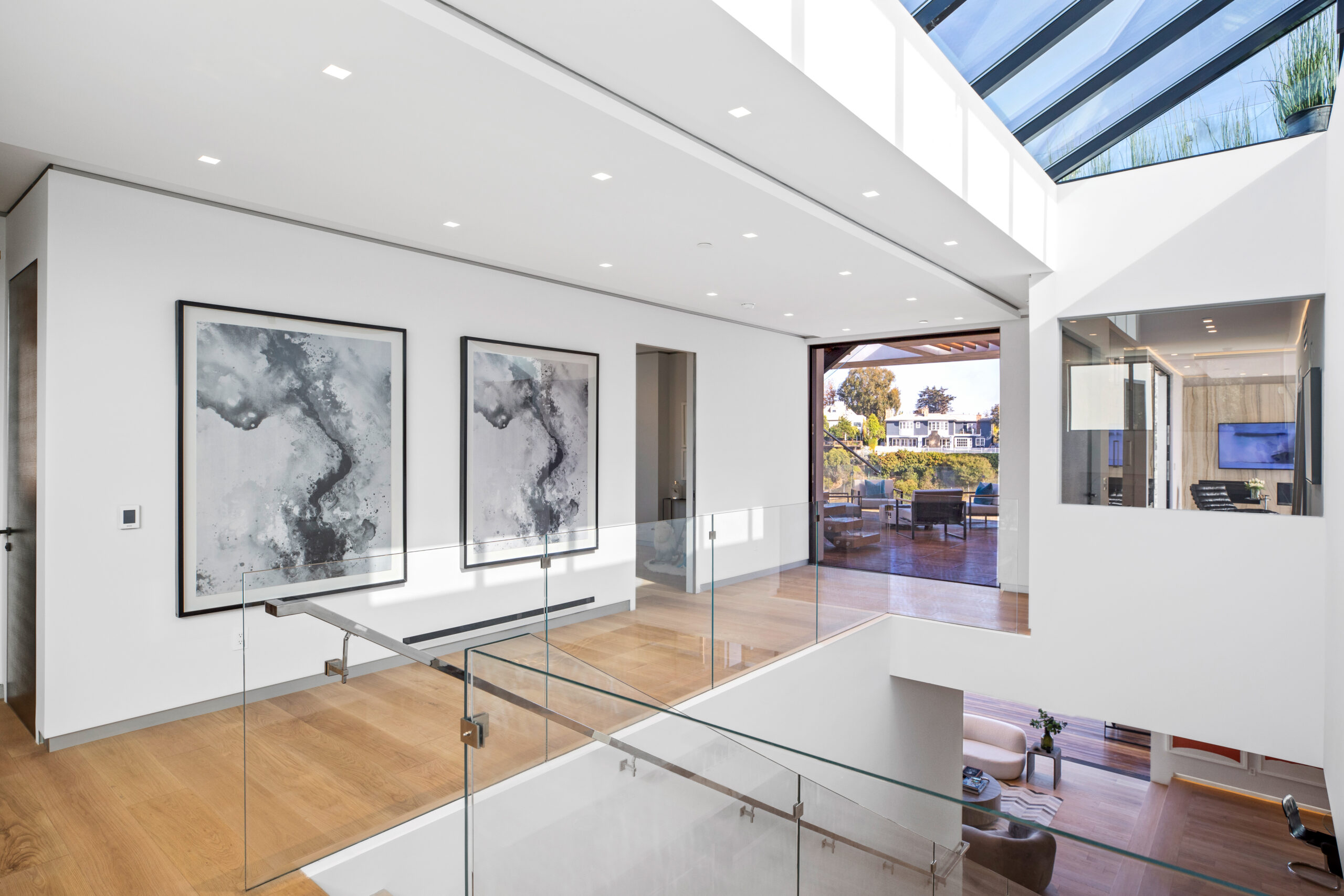
Why small lighting details become big field problems.
Cove, reveal, toe kick, and stair tread lighting all look simple in a drawing. They’re a line on an elevation, a note on a section, an arrow pointing at a profile callout. In the field, every one of them depends on edge conditions — returns, corners, nosings, cabinet faces, drywall planes, finished flooring, access points — that the drawing alone can’t resolve. When those conditions get simplified or improvised, the detail fails in ways that are very visible from across the room.
The other reason these details fail is that they touch every trade on the project. The GC, the electrician, the framer, the finish carpenter, the cabinetmaker, the stone fabricator, and the controls integrator all need the same geometry. When the geometry isn’t shared early, each trade builds toward a slightly different version of the detail, and the LED line ends up compromised.
Cove lighting.
Cove lighting is the most common architectural LED detail in luxury homes — a continuous strip hidden where the wall meets the ceiling, washing the ceiling so it appears to float. It’s also the detail that fails most often, because the cove geometry has to balance four things at once: setback, channel depth, lens type, and the brightness needed to actually wash the ceiling.
The common failure modes:
- The LED source is visible from sightlines the architect didn’t anticipate.
- The wash on the ceiling falls off too quickly because the channel is too shallow.
- The cove reads as a row of dots because the lens type doesn’t diffuse the LED density.
- The cove gets shortened during framing and the LED line stops short of the corner.
Reveal lighting.
Reveal lighting lives or dies on dimensional precision. The reveal itself — the gap between two architectural elements — has to be sharp, consistent, and deep enough to hide the LED source while still letting the line read. When reveal depth gets value-engineered without the LED contractor in the loop, the LEDs end up showing through the gap.
The common failure modes:
- The reveal depth was reduced during framing without consulting the LED scope.
- The framing tolerances drifted, and the reveal line wanders.
- The two architectural elements that form the reveal aren’t in the same plane, so the line of light has visible steps.
- The wire path crosses structure that wasn’t coordinated at rough-in.
Toe kick lighting.
Toe kick lighting is the detail that gets the kitchen island or vanity to appear to hover. The light bounces off the floor finish; the LED source has to be invisible from standing sightlines. It sounds simple, but it sits at the intersection of cabinetry, electrical, and finish flooring, which is where it tends to break down.
The common failure modes:
- The cabinet face changes after the toe kick light is roughed in.
- The LED is mounted too close to the toe-kick gap and the source shows.
- The floor finish is darker than expected and the bounce reads as a dim wash.
- The driver location ends up behind a finish surface with no access for service.
Stair tread lighting.
Stair tread lighting is one of the most demanding details in a luxury build. Each tread or stair-side run has to be consistent across the whole staircase, the LED source has to be invisible to the user, and the entire run needs to be serviceable without dismantling the stair.
The common failure modes:
- The wire path fights the structural framing of the stair.
- Heat from the LED tape isn’t managed and the LEDs degrade prematurely.
- There’s no service plan, so a failed driver becomes a destructive repair.
- The tread detail changes after install, and the LED line doesn’t move with it.
What has to be coordinated before install.
Across all four detail types, the same coordination items decide whether the line lands clean:
- Channel profile and lens choice, matched to the geometry of the detail.
- Setback from the visible edge, confirmed against actual sightlines.
- Blocking, wire path, and driver location, set into framing before drywall.
- Finish-face plane and finish material, including how the reflectance affects the line.
- Access strategy for service, so a $40 part doesn’t become a destructive repair.
- Dim protocol and driver behavior, matched to the controls strategy.
How LIT Group prevents detail failure.
We define the assembly first. We check the sightline against the actual cove or reveal geometry, not just the elevation. We coordinate the rough-in with the GC and the electrician so the channel goes in before drywall, the wire path is clean, and the driver is in an accessible location. We fabricate or install the LED components around the real field condition.
The goal is a detail that reads exactly the way the architect drew it — and that can still be serviced five years later without tearing into a finished surface.