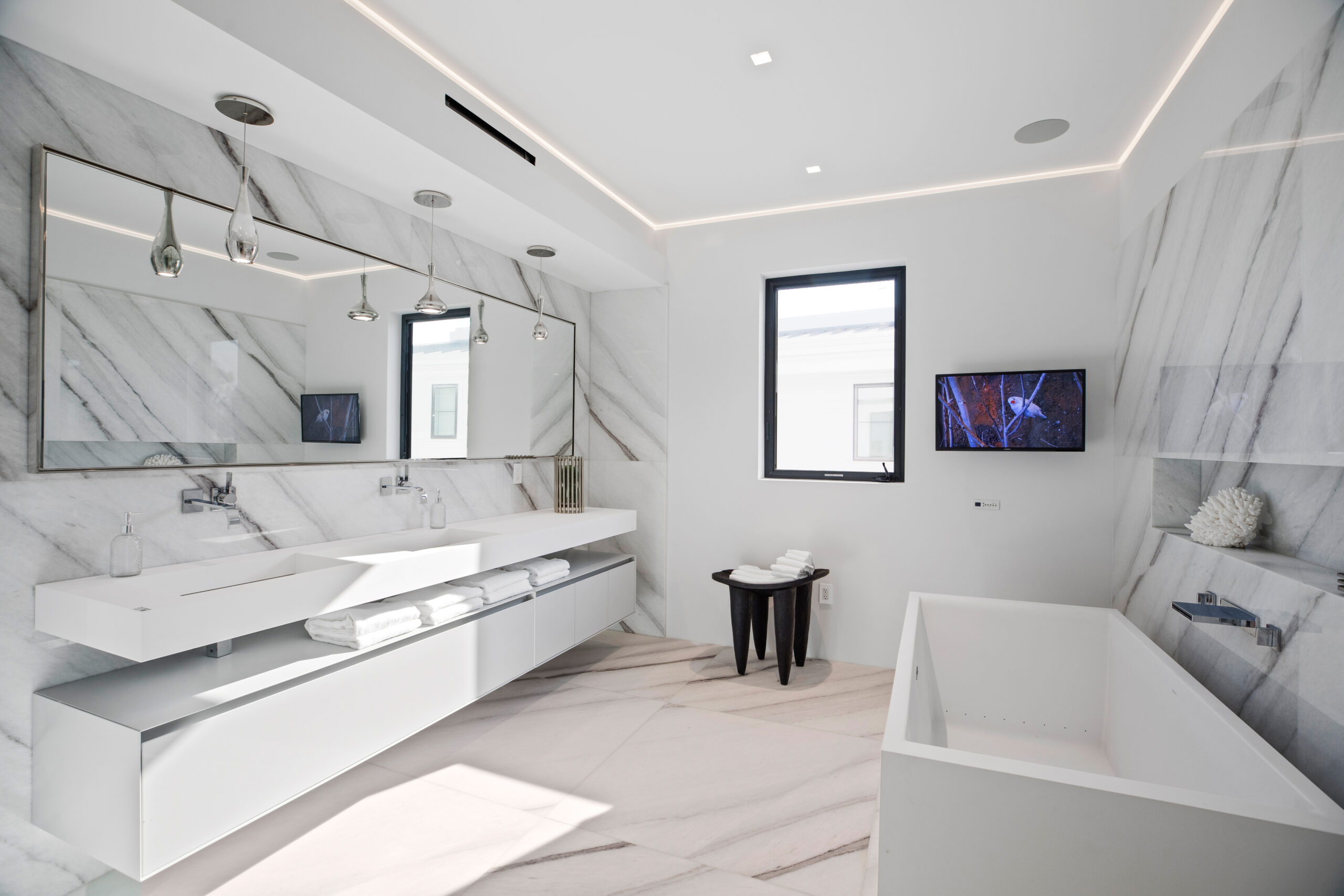
Why specialty LED touches more than one trade.
The specialty LED scope on a luxury residential project — concealed linear, backlit stone, illuminated stair treads, custom assemblies — isn’t a single-trade problem. A single backlit onyx wall can require decisions from the stone fabricator, the electrician, the cabinetmaker, the GC, the architect, the designer, and the controls integrator before fabrication starts. If any one of those decisions is missing, the field condition shifts and the detail compromises.
That’s the coordination problem in one sentence: specialty LED scope lands in the gaps between trades. It’s not standard electrical, not standard millwork, not standard finish. It depends on all of them, and it falls apart when no one team is responsible for the line.
The visible failure modes are familiar to anyone who’s walked a luxury build at the wrong moment. The cove that doesn’t reach the corner because nobody told the framer to extend the channel. The backlit stone wall that lights unevenly because the panel array was specified after the slab was cut. The stair tread detail with no service path. The driver behind a finished surface that nobody can reach. Each one of those failures is the result of a coordination gap, not a craft problem.
GC coordination.
The general contractor sets the schedule, the trade sequence, and the scope boundaries. When the specialty LED scope is assigned cleanly — one named subcontractor with a defined boundary — the GC has one team to talk to about the LED line. Bid coverage, RFI responses, and field coordination all flow through one channel. The GC doesn’t have to mediate between trades who disagree about who owns what part of the detail.
Electrical coordination.
The electrician owns the standard branch wiring, devices, and lighting circuits. The specialty LED contractor owns the channels, drivers, dim protocol, and custom assemblies. The boundary between them has to be defined before rough-in: where does power stop, where does specialty LED begin, who runs which low-voltage cables, where do drivers live, what dim protocol is the project running.
When that boundary is clean, the electrician focuses on what they do well and the specialty LED contractor handles the slow, detail-driven work. When it’s not, the electrician inherits scope they didn’t price and the LED detail compromises.
Stone coordination.
Backlit stone requires the most coordination of any specialty LED detail. The stone fabricator needs the lightbox dimension before they cut. The LED contractor needs the slab translucency, vein structure, and elevation before fabricating the panel array. The cabinetmaker needs to know how the elevations change once a recessed cavity is part of the assembly. The GC needs to know the timing.
LIT Group sits in the middle of that conversation. We give the stone shop the dimensions and access notes they need to build to, without asking them to take on the LED scope. The fabricator stays focused on stone selection, slab cutting, and setting; we own the panel design, the driver coordination, the install sequence, and the on-site tuning. The handoff between the two trades stops being a conversation about responsibility and becomes a conversation about dimensions.
Cabinetry coordination.
Cabinetry intersects specialty LED on toe kicks, floating cabinets, kitchen islands, vanities, and integrated millwork. The cabinetmaker needs to know toe-kick depth, channel routing, shelf-light placement, and any elevation shifts caused by integrated lighting. When that’s coordinated against the cabinetmaker’s shop drawings, the LED detail and the cabinetry land together. When it’s not, one of them gets simplified at install.
Architect and designer coordination.
The architect and designer set the intent. LIT Group’s job is to translate that intent into a buildable assembly that holds through the trades. We work directly with the design office to mark up details, recommend channel selections, run sample tests, and protect the detail through bidding, rough-in, and finish. The design team doesn’t have to police the LED scope across every other trade; we do that.
Controls coordination.
The controls integrator is the last team to touch the lighting system before the architect signs off. They need a documented LED scope: fixture schedule, driver list, dim protocol, zone map, and access strategy. We hand that over at rough-in so the integrator can program against documented hardware instead of discovering it at commissioning. We coordinate with the major luxury residential platforms — Lutron, Crestron, Control4, Savant — alongside the dim protocol the integrator is running.
When the LED side and the controls side are aligned at rough-in, commissioning becomes the architect’s sign-off pass instead of a discovery exercise. The dim curves hold. The scenes program against documented zones. The system is stable from day one instead of fragile.
What to send to LIT Group.
Coordination starts with information. An early review usually only needs a partial submission and a quick conversation. Send what’s available:
- Architectural drawing set or relevant elevations, plans, and RCPs.
- Lighting design intent — renderings, references, or precedent images.
- Stone selections for any backlit assemblies.
- Cabinetry and millwork drawings.
- Electrical sheets and any control narrative if available.
- Project schedule with framing, drywall, stone fabrication, and finish dates.
We come back with a defined specialty LED scope, the coordination items that need attention, and a path that keeps every trade clean. The earlier we’re in, the less coordination work everyone else has to do.