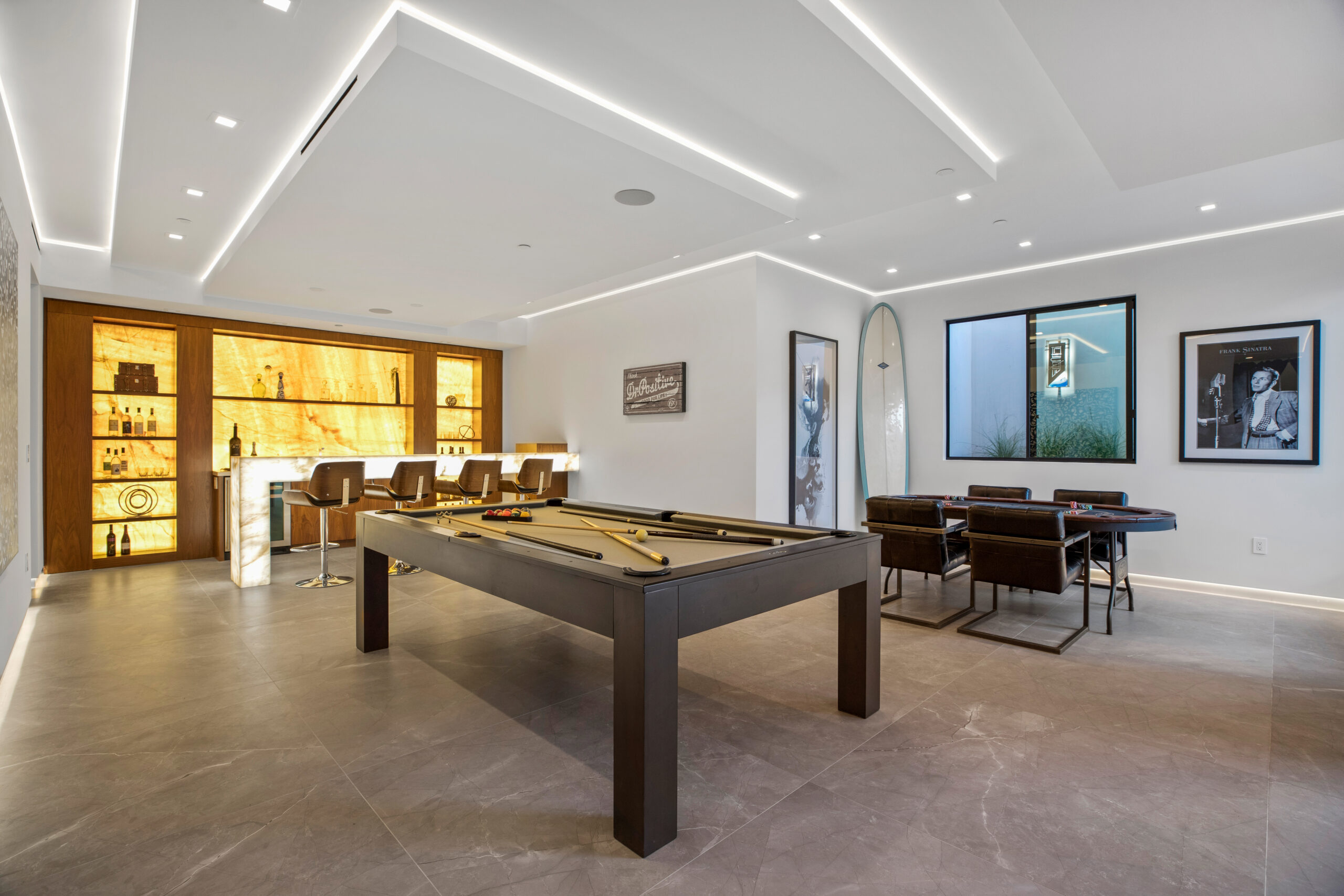
What an architectural LED contractor actually does.
An architectural LED contractor is a specialty subcontractor who owns the parts of the lighting scope that don’t fit cleanly inside standard electrical work. That means concealed linear lighting in coves, reveals, stair treads, toe kicks, and millwork; backlit natural stone in islands, walls, and vanities; and custom assemblies built into the architecture itself. The fixture disappears. The light reads as part of the building.
The work is finish-grade. It depends on aluminum channel selection, lens and diffusion strategy, color temperature, dim protocol, driver location, and field sequencing. None of that is mysterious, but all of it has to happen at the right moment in the build, with the right level of attention. That’s the contractor’s job.
When standard electrical scope is not enough.
Most luxury residential projects start with a competent electrician. The electrician is excellent at branch wiring, devices, panels, and the standard lighting scope — recessed cans, fixtures, switches. The specialty linear and backlit stone work is a different scope. Aluminum channels go in before drywall. Drivers and dim curves have to match the controls platform. Backlit stone has to be coordinated against the stone fabrication schedule, not pulled together at the end.
The result is a real economic problem for the electrician: their crews can install a hundred recessed cans in the time it takes them to do ten days of careful linear LED work. Most electricians know this and would rather skip the specialty scope. Asking them to take it on anyway is how projects end up with simplified coves, retrofitted stair details, and backlit stone that doesn’t read evenly.
Why timing matters.
The single most important variable on a specialty LED project is when the LED contractor is brought in. Almost everything that can go wrong — missing channel cavities, drivers in inaccessible locations, stone elevations that don’t match the lightbox, dim curves that don’t hold — comes from getting the LED scope involved too late.
The cleanest path is to have the specialty LED contractor reviewing drawings during design development or early pre-construction. That’s when framing depth, cabinet elevations, stone backing, electrical rough-in, and wiring paths can still be adjusted without treating the LED scope as a late correction.
Projects that need early LED coordination.
Some projects are obvious candidates. Others quietly require the same kind of coordination and don’t get it. Bring a specialty LED contractor in early when the project includes any of:
- Concealed cove or reveal lighting in primary rooms or hallways.
- Stair tread or stair-side lighting on a feature staircase.
- Toe-kick or floating-cabinet lighting on a kitchen island, vanity, or built-in.
- Backlit translucent stone — onyx, quartzite, marble — on any island, bar, vanity, or feature wall.
- Linear ceiling features, illuminated millwork, or any custom LED assembly the architect has detailed.
- Exterior architectural reveals, soffit lighting, or pool coping lighting.
If the architect has drawn it as a line of light or a glowing surface, somebody has to be responsible for translating that into a buildable assembly. That’s the role.
Who LIT Group coordinates with.
Specialty LED scope sits between trades. On a typical luxury residential build, LIT Group is in active conversation with:
- The general contractor — on schedule, scope boundary, and trade sequencing.
- The electrician — on circuit loading, driver placement, J-box layout, and dim protocol.
- The stone fabricator — on lightbox dimensions, slab cut timing, and access strategy.
- The cabinetmaker — on toe-kick depth, shelf detail, and elevations affected by integrated lighting.
- The architect and designer — on intent, channel selection, finish-face geometry, and final tuning.
- The controls integrator — on driver brand, dim protocol, zone breaks, and access for service.
The point is to give every trade one clear LED resource for the details that affect their work.
What to send for review.
An early review usually only takes a partial drawing set and a quick conversation. Send what’s available:
- Architectural drawing set or relevant elevations, plans, and RCPs.
- Lighting design intent — renderings, references, or precedent images.
- Stone selections for any backlit assemblies.
- Cabinetry and millwork drawings.
- Electrical sheets and any control narrative if available.
- Project schedule with framing, drywall, stone fabrication, and finish dates.
We come back with a defined specialty LED scope, the coordination items that need attention for the team to confirm, and a budget number for the line. The result is a clearer scope and a cleaner installation path.